OPC UA Buch
 Das erste OPC Unified Architecture Buch, geschrieben von Wolfgang Mahnke, Stefan-Helmut Leitner und Matthias Damm, einem der Gründer von ascolab.
Nachrichten
MES und OPC UA Connectivity
Erlangen Oktober 2011. ascolab ist Gründungsmitglied der MES Connectivity Arbeitsgruppe und Editor der Companion Specifikation. Die OPC Foundation und MES Hersteller aus der MES Dach Gruppe starten eine OPC UA Zusatztspezifikation speziell für MES. Diese Informationsmodell definiert eine OPC UA konforme Abbildung von MES Objekten und Informationen. Das Ziel ist einen Satz von Typen in einem dedizierten MES Namensraum zu definieren der standardisiert wird und von MES Systemen interpretiert werden kann, die über OPC UA kommunizieren und direkt mit der Prozessebene verbunden sind.OPC UA auf iPhone portiert
Erlangen, April 2011. ascolab wurde beauftragt den ANSI C OPC UA Stack auf Apple Betriebssysteme zu portieren. Das Ziel ist es OPC UA Anwendungen direkt auf dem iPhone und iPad ablaufen zu lassen. Der OPC UA Stack erfolgreich portiert und erste Client und Server Applikationen wurden getestet. Dieser Ansatz bringt den industrieerprobten, robusten und sicheren Kommunikationstandard auf Geräte der Konsumerelektronik und eröffnet neue Anwendungsfelder im Bereich mobiler Maschinenüberwachung und in Logistikanwendungen.SPS/IPC/Drives 2010
Nürnberg 23. - 25- November, 2010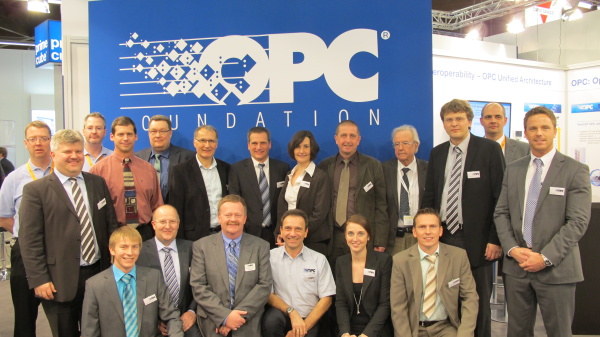 ascolab GmbH zeigte die OPC UA Technologie auf der SPS/IPC/Drives. Auf dem beeindruckenden neuen Stand der OPC Foundation (7-190) präsentierte ascolab Entwicklungs- und Trainingsdienstleisungen für OPC UA. Der Gemeinschaftsstand stand unter dem Motto "From Controller into the Cloud" und demonstrierte die Vorteile von OPC UA Kommunikation in modernen IT Infrastrukturen. Besucher konnten sich Live-Demonstrationen verschiedener SPS-Hersteller und HMI/SCADA Systeme anschauen, die bereits OPC UA-fähig sind. Das große Team der Aussteller verschiedener OPC Mitgliedsfirmen beantwortete alle Fragen rund um Unified Architecture und dessen Anwendung im Feld.
OPC UA auf der Security Messe in Essen
08. Oktober, 2010 Essen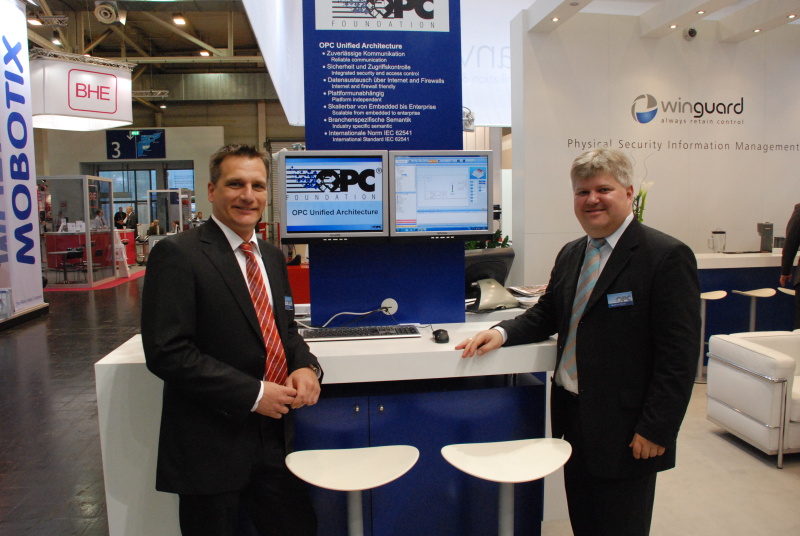 Die ascolab GmbH vertrat die OPC Foundation auf der alle zwei Jahre stattfindenden Security Messe in Essen und stellte die OPC UA Technologie einem interessierten Publikum vor. Viele Besucher und Aussteller kannten die klassischen OPC Standards, aber die neuen Möglichkeiten und die Flexibilität von OPC Unified Architecture begeisterte sie. Höchstes Interesse weckte die plattformunabhängige, sicher Kommunikation in Brandmeldeanlagen, Zutrittstkontrollsystemen, Kartenlesern und Türschließsystemen und auch in dem großen Feld der Videoüberwachung. Diese Messe eröffnete neue Möglichkeiten für OPC Unified Architecture in einem aufstrebenden Markt nicht nur für Management- und Visualisierungssysteme auch für Gerätekommunikation. Gerätebeschreibung und Diagnose müssen - analog zu intelligenten Feldgeräten in der Industrieautomation - standardisiert werden. Hersteller und Integratoren waren sich einig dass eine Taskforce untersuchen sollte wie OPC UA ihnen helfen kann nachhaltige Lösungen für ihre Kunden zu schaffen.
COSMOS - EU Research Project
Cost-driven Adaptive Factory based on Modular Self-Contained Factory Units
Wind turbine manufacturing and aeronautics are two sectors where Europe is leading the world class competition. To guarantee this competitiveness in the future, productivity in the relevant manufacturing processes has to be improved. In the wind turbine manufacturing industry, assembly is one of the core processes in the full production chain. Most of these assembly operations are executed manually with the aid of different tools and gauges - the main disadvantages are a relatively high degree of variability, low process stability, the necessity to repeat certain tasks that are difficult to perform correctly first time and the generation of a high rework rate.
Objectives
The main objectives for COSMOS are the design, development and implementation of a distributed control system for the management of a factory with a flexible, modular and evolvable automation approach capable of increasing the assembly factory productivity by 20% without compromising on flexibility. Although the project will focus on the wind turbine assembly process, the conception of the solution will be suitable for other sectors including aeronautics and railway industries.
- Create a factory organisation concept based on intelligent factory units facilitating self-adaptation to changes in product/production on a flexible and modular automation configuration basis.
- Design and develop a distributed control system architecture, which will take into account the conceived factory unit organisation and its modular configuration, and, additionally, will be capable of synchronising different factory units.
- Design and develop the service layer infrastructure between the control system and the equipment/devices involved in the production activities. This service layer will enable:
- The interoperability with new devices in the modular factory units in a seamless, plug-and-use way, thus, facilitating the scalability of the solution.
- The integration of task-oriented, automated sub-systems as it is envisaged to be the case for a variety of complex assembly, testing and inspection operations.
- Define cost models to optimise the factoryunit configuration in terms of automation and modularisation. Such models will consider also the potential of adaptation capabilities with regards to new product demands.
Seite 3 von 10